Donald Duncan Cameron (1878-1941) – Diary of his Journey to Canada by Sea, March 1905
Note from Pamela Forsyth in Edmonton, Alberta, June 9, 2024:
Recently, the DIARY written by my grandfather Donald Duncan Cameron (1878-1941) of his sea journey to Canada in 1905 has come to light. I have posted scans of it here along with some other photos and information related to his life and his decision to emmigrate to Canada from his home in Berwick-upon-Tweed, the small city near the Scottish/ English border where he was born and raised.
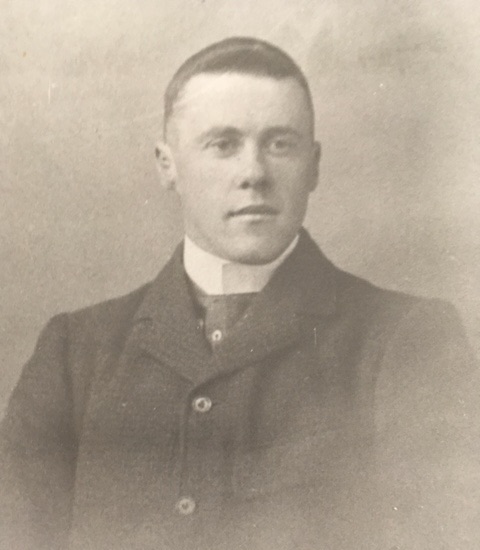
Donald Duncan Cameron (1878-1941) Photo courtesy of Robert Cameron.
In March 2024 my cousin Ferne (née Cameron) Jensen/Mills (1949-2024) of Maryfield, Saskatchewan died, leaving a trove of photos and other items which are being scanned and organized for her family by her friend Sharon Thiessen. In the course of this work Sharon discovered a small notebook which Grandfather Cameron wrote in March 1905. Sharon’s scans of this notebook have been shared with me and others in Ferne’s extended family so they can be accessible to Donald Cameron’s many descendants. He had five children and fifteen grandchildren, and now has many great and great-great grandchildren. His first grandchild was born less than two months before he died in 1941 so none of his grandchildren ever knew him. This diary, written as he travelled to Canada at the age of 26 years, gives us a very personal insight into the young man he was.
Decision to emigrate to Canada
Although his father John Cameron (1845-1932) was a veterinarian, a career path followed by Donald’s younger brother, another John Cameron (1883-1920), Donald wanted to be a farmer like many of his Scottish ancestors. In the 1901 English census when he was 22 years old his occupation was listed as “Apprentice farmer”. At that time he was living and working on a farm in Northumberland next door to the farm where his future wife, Isabella Brownlee (1874-1958) was living with her grandparents, Peter Allan (1823-1905) and Sarah (née Short) Allan (1824-1902).
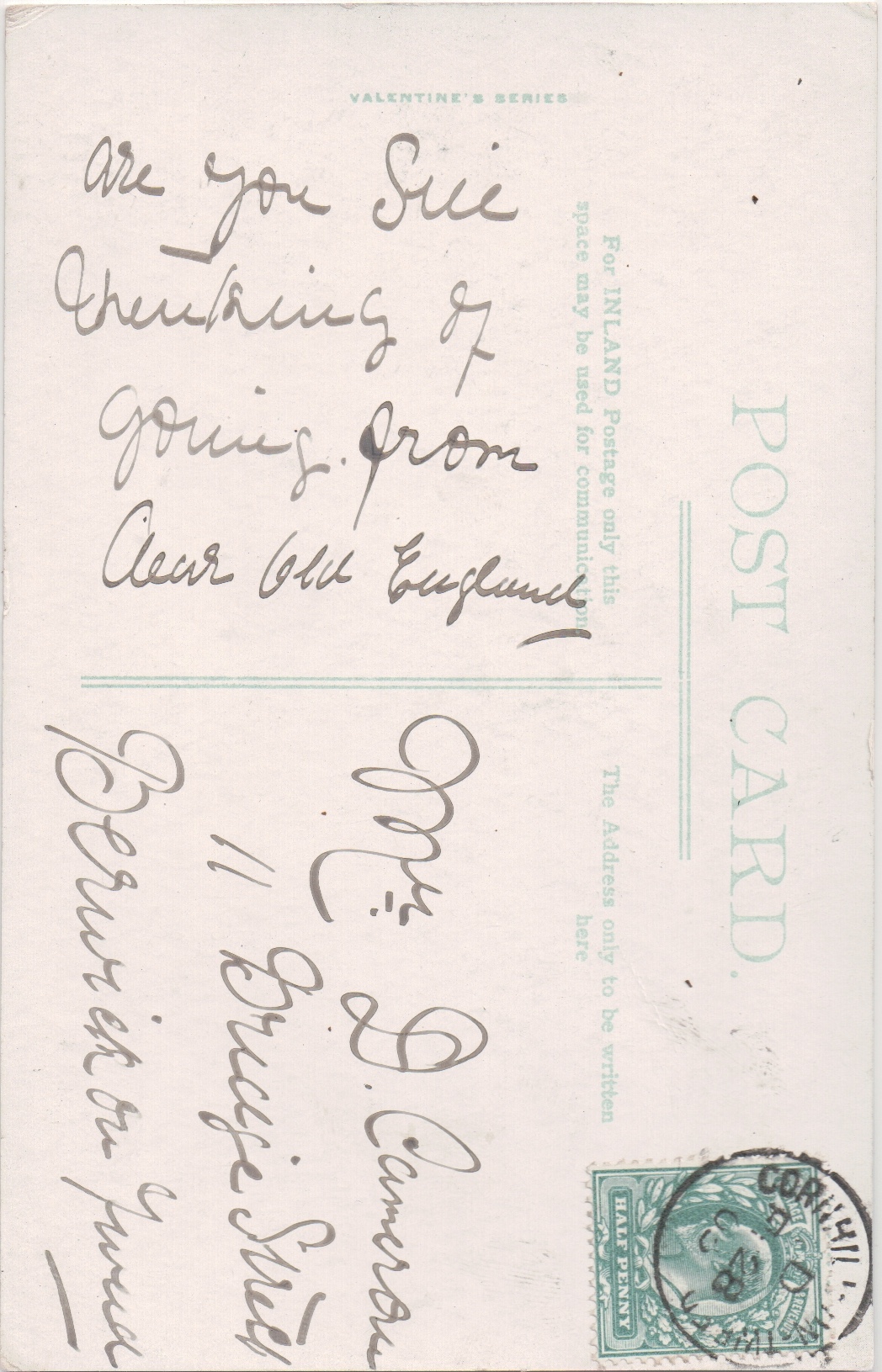
Many people in the United Kingdom at that time were enticed to emigrate to Canada where the opportunities to obtain a farm were greater than in England or Scotland so he decided to try farming in Canada. As late as February 28, 1905 my grandmother wrote to him on the post card below saying, “Are you still thinking of going from dear old England”. It is obvious that she was still hoping that he might change his mind!
To: Mr D. Cameron, 11 Bridge Street, Berwick-on-Tweed. “Are you still thinking of going from Dear Old England?” Although it is unsigned I know, from the postal location and her familiar handwriting, that it was written by Isabella Brownlees. Postmarked at Cornhill on Tweed Feb 28, 1905.
On March 3, 1905 Donald Cameron set sail for Canada aboard the ship SARMATIAN. There were 163 passengers on board in addition to the crew. The ship could legally transport 274 passengers so the ship was only about sixty percent full. Also on board were friends of Donald – John Matthewson (1874-1947), his wife Christina (née Johnston) Matthewson (1872-1940) and their six-year old son Adam.
Grandpa’s handwriting is very legible, but for easier reading, I have also included a typed transcription of each of the pages. The diary is short, about thirteen pages, but I have also included copies of the blank pages and those on which he later made a few miscellaneous notes and calculations of expenses, etc.
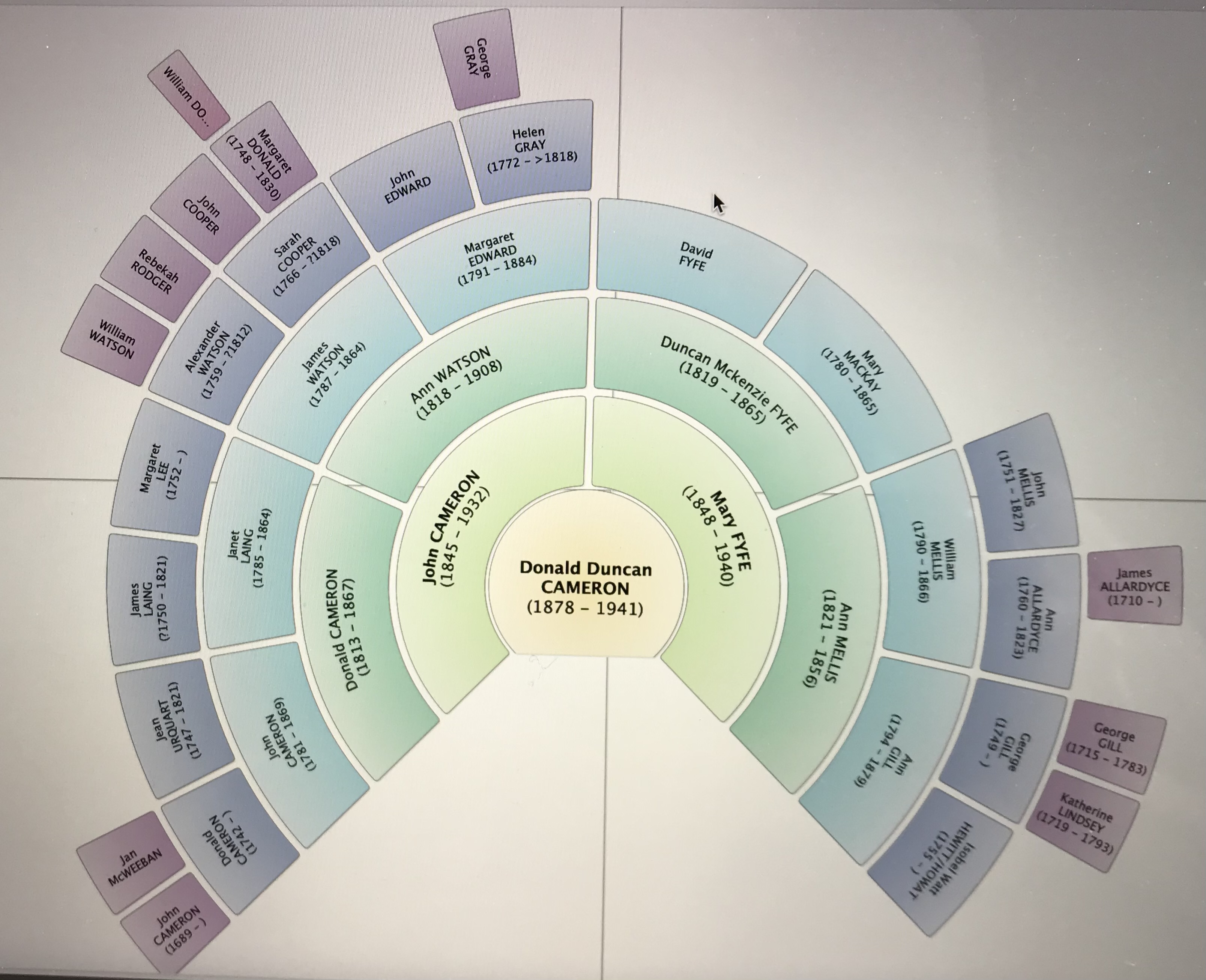
For general interest, I have added: some photos of the Cameron family home in Berwick-on-Tweed; Donald Cameron as a young man; his fiancée, and later wife, Isabella Allan Brownlees; the post card he sent to Isabella after he arrived in Halifax; another postcard sent to Donald at Galt, Ontario; information about the ship, Sarmatian, on which he sailed to Canada; brief Ancestry Charts for both Donald Cameron and Isabella Browwnlees.
[Scans of the cover and all pages of the Diary are courtesy of Sharon Thiessen]
It was written in a small notebook, about 3.5 by 6 inches. Although it is unpaged I have added Page Numbers just to make reading it a bit easier. By 1905 an Atlantic crossing from Glasgow to Halifax usually took about 5 to 7 days. Grandpa’s voyage took 18 days, an indication of what a rough crossing he endured.
DIARY COVER
The small size and modest black cover of the notebook (about 3.5 by 6 inches) is probably why it remained unnoticed for all these years among other photos and papers. Scans of the cover and all pages of the Diary are courtesy of Sharon Thiessen.
Page One
“Donald D. Cameron, 11 Bridge Street, Berwick-on-Tweed, Scotland”. The address is his parents’ home and where he was living at the time he departed for Canada. [I am guessing that the scribbles on this and some other pages were added by a child or grandchild much later in the diary’s history.]
Two photos of the street and home where the Camerons lived:
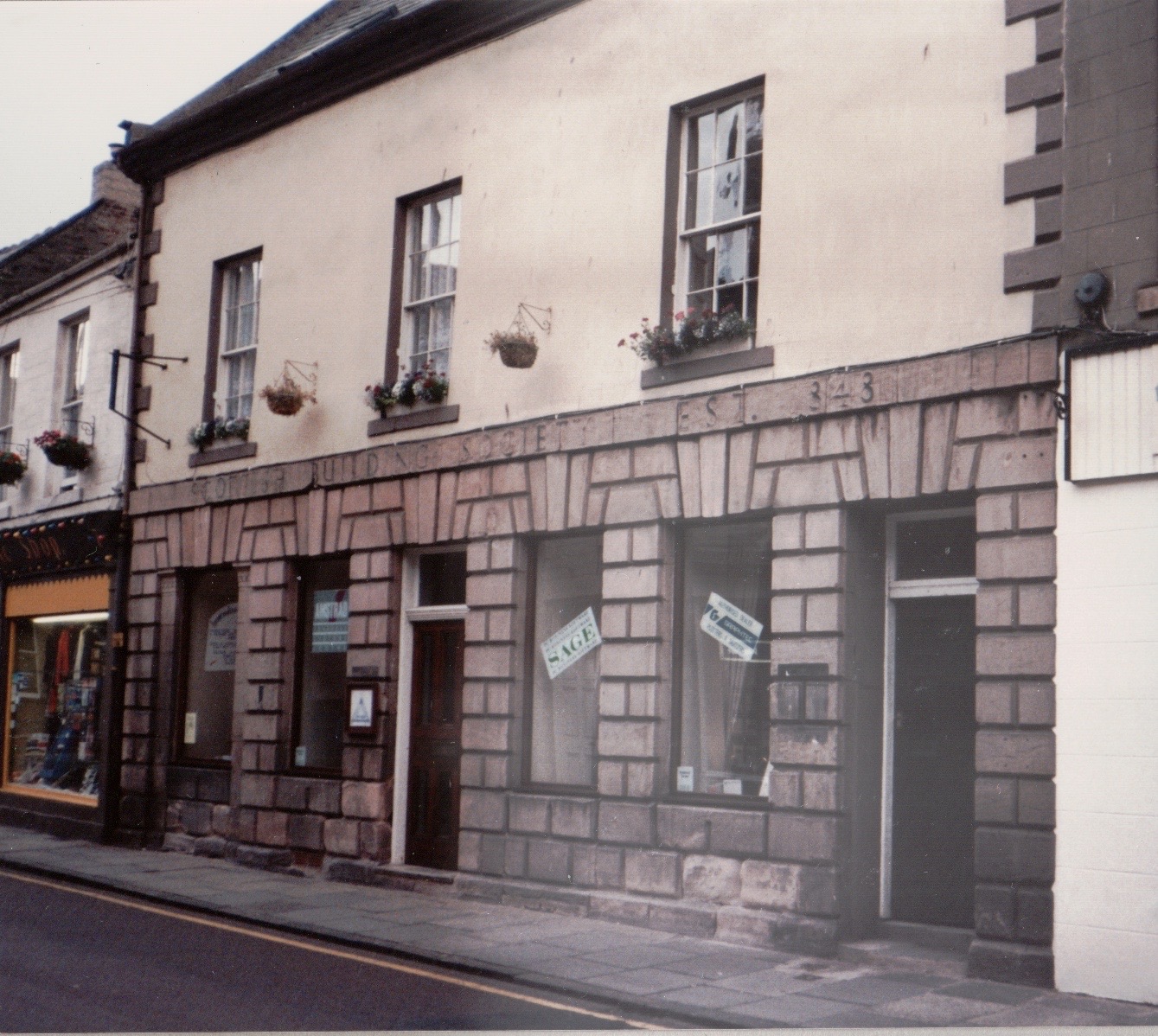
This photo of Bridge Street in Berwick-on-Tweed was taken in the 1890s, a few years before Donald left for Canada. The Cameron home at 11 Bridge Street was about half way down the street on the right hand side. His father’s Veterinary business was housed on the main floor and the family lived in the apartment above. (Photo courtesy of the Town Archives in Berwick-on-Tweed, obtained on my visit there in 1990.)The house that the Camerons lived in on Bridge Street (which included both number 9 and number 11) was still there in 1990 and 1999 when I visited the town. The Veterinary office was a computer store in 1990 and had become a real estate (aka Estate Agent’s) office by 1999. The apartment above had become a Bed & Breakfast.
Page Two
Transcription of Page Two:
“March 3, 1905 sailed from Glasgow @ half past nine at night. The weather was pretty quiet the first day but after that it turned very stormy & mostly every one was sick for two or three days. The ship rolled very badly, sometimes the bows were right down under water and the propellers @ the stern right up in the air out of the water altogether. The sea was lashing right over the deck every few minutes which made walking on deck very dangerous. The chief steward had a very narrow escape from being washed overboard being half through the rails before stoppinghimself so I leave you to guess how rough it was. On Friday night the weather became so stormy that”
Page Three
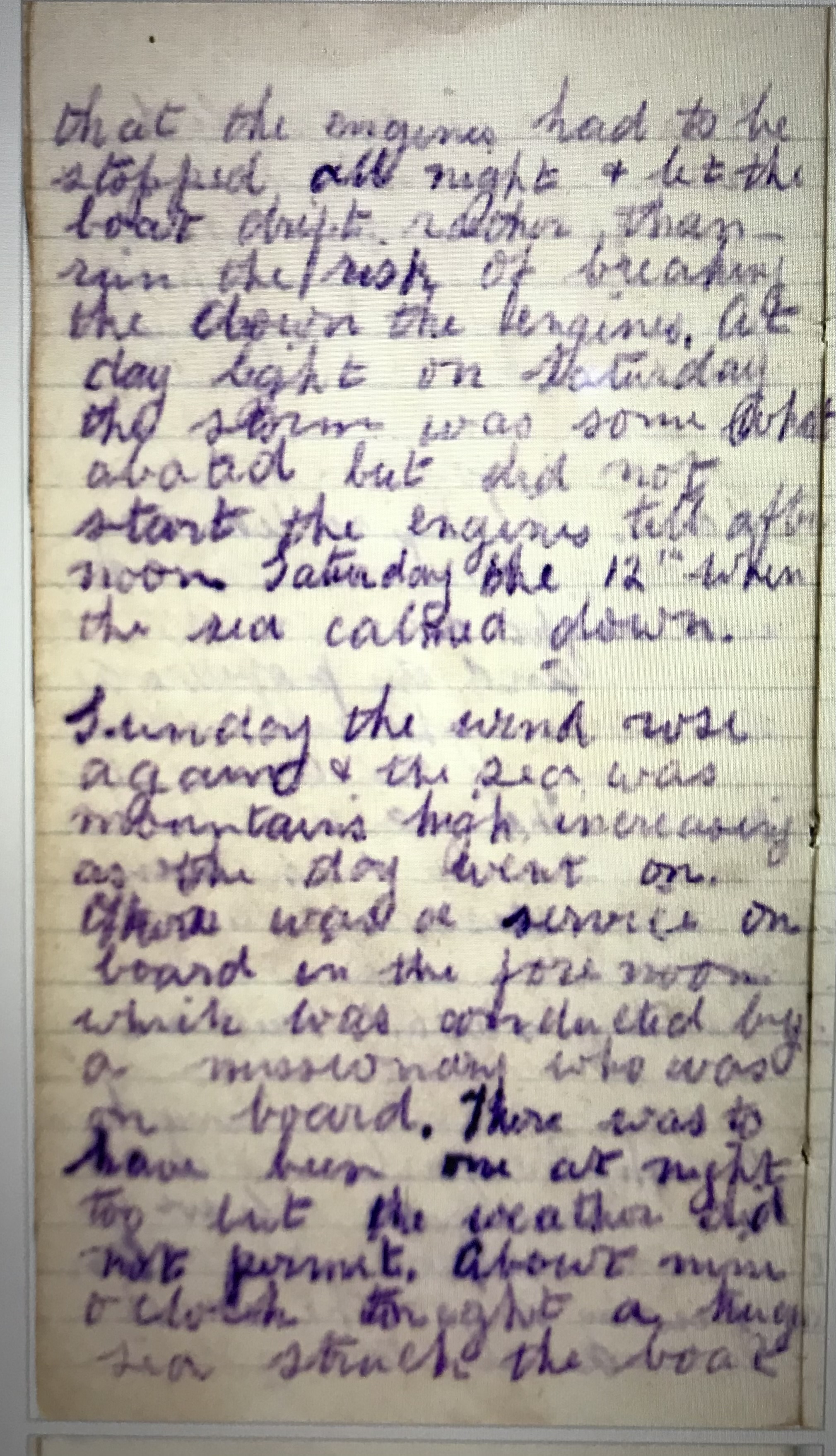
Transcription of page Three:
“that the engines had to be stopped all night & let the boat drift rather than run the risk of breaking [the] down the engines. At day light on Saturday the storm was some what abated but did not start the engines till afternoon Saturday the 12th when the sea calmed down.
Sunday the wind rose again & the sea was mountains high increasing as the day went on. There was a service on board in the forenoon which was conducted by a missionary who was on board. There was to have been one at night too but the weather did not permit. About nine o’clock tonighta huge sea struck the boat”
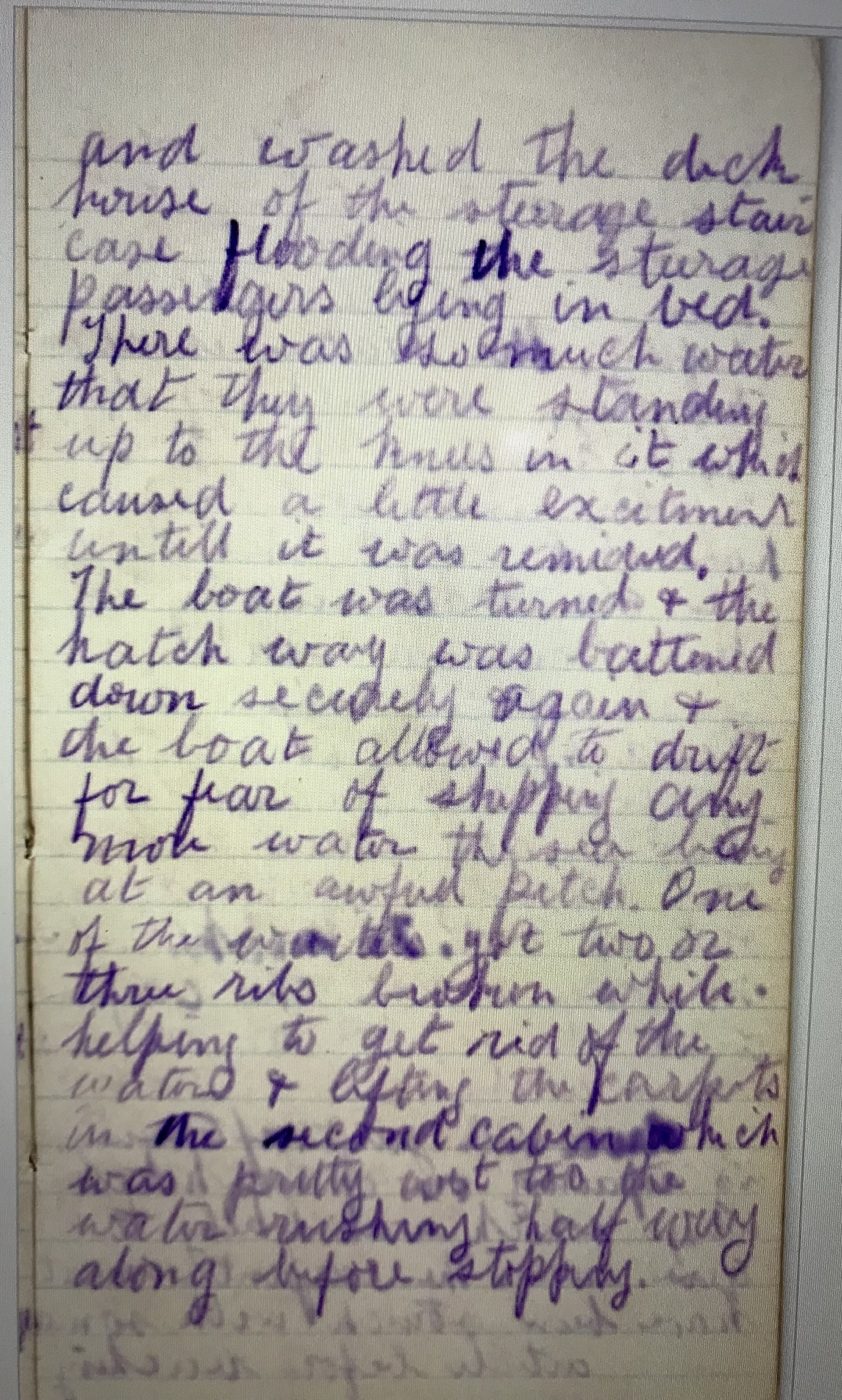
Page Four
Transcription of Page Four:
“and washed the deck house of the steerage staircase flooding the steerage passengers lying in bed. There was so much water that they were standing up to the knees in it which caused a little excitement until it was remedied. The boat was turned & the hatch way was battened down securely again & the boat allowed to drift for fear of shipping any more water the sea being at an awful pitch. One of the waiters got two or three ribs broken while helping to get rid of the water & lifting the carpets in the second cabin which was pretty wet too the water rushing half way along before stopping.”
Page Five
Transcription of Page Five:
“Monday was still very rough & too stormy to proceed against such a sea so we are still drifting. The water is seeping through the deck of the whole vessel which makes it very uncomfortable, some having to shift their beds for the water coming in. The floors are soaking & most of the carpets are lifted & make it very uncomfortable because one has to get their boots on before jumping down out of bed. To make matters worse the carpenter and the fourth mate were washed overboard & drowned just after finishing repairing one of the hatchways which was likely to give away. The carpenter must have been struck with some heavy article before reaching”
Page Six
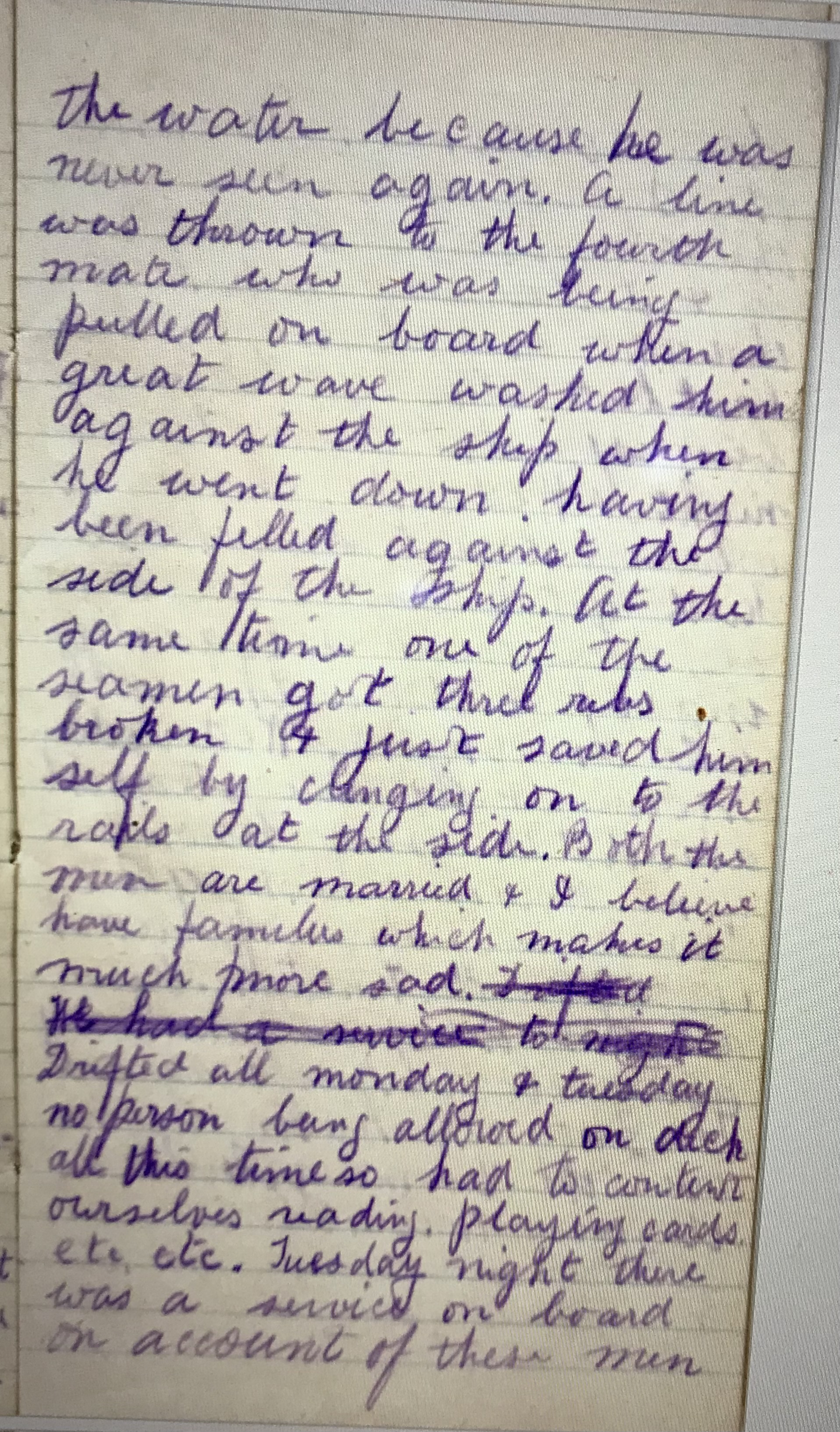
Transcription of Page Six:
“the water because he was never seen again. A line was thrown to the fourth mate who was being pulled on board when a great wave washed him against the ship when he went down having been felled against the side of the ship. At the same time one of the seamen got three ribs broken & just saved himself by clinging on to the rails at the side. Both the men are married & I believe have families which makes it much more sad. Drifted all Monday & Tuesday no person being allowed on deck all this time so had to content ourselves reading, playing cards, etc, etc. Tuesday night there was a service on board on account of these men”
Page Seven
Transcription of Page Seven:
“being drowned. The time the service was going on the storm was most terrific & I dare say most of us thought ever[y] heavewas our last but allas we have yet being spared. I think Tuesday night & Wednesday morning were the worst we have had yet because I never slept a wink & was slipping up & down the bed like an engine. Wednesday morning & we are steaming ahead, the sea having gone down which gives us some hopes of reaching our destination. After all this delay we are only about halfway on our voyage having gone over the same ground as it were twice. Friday afternoon & we have been going along a treat since Wednesday but will take”
Page Eight
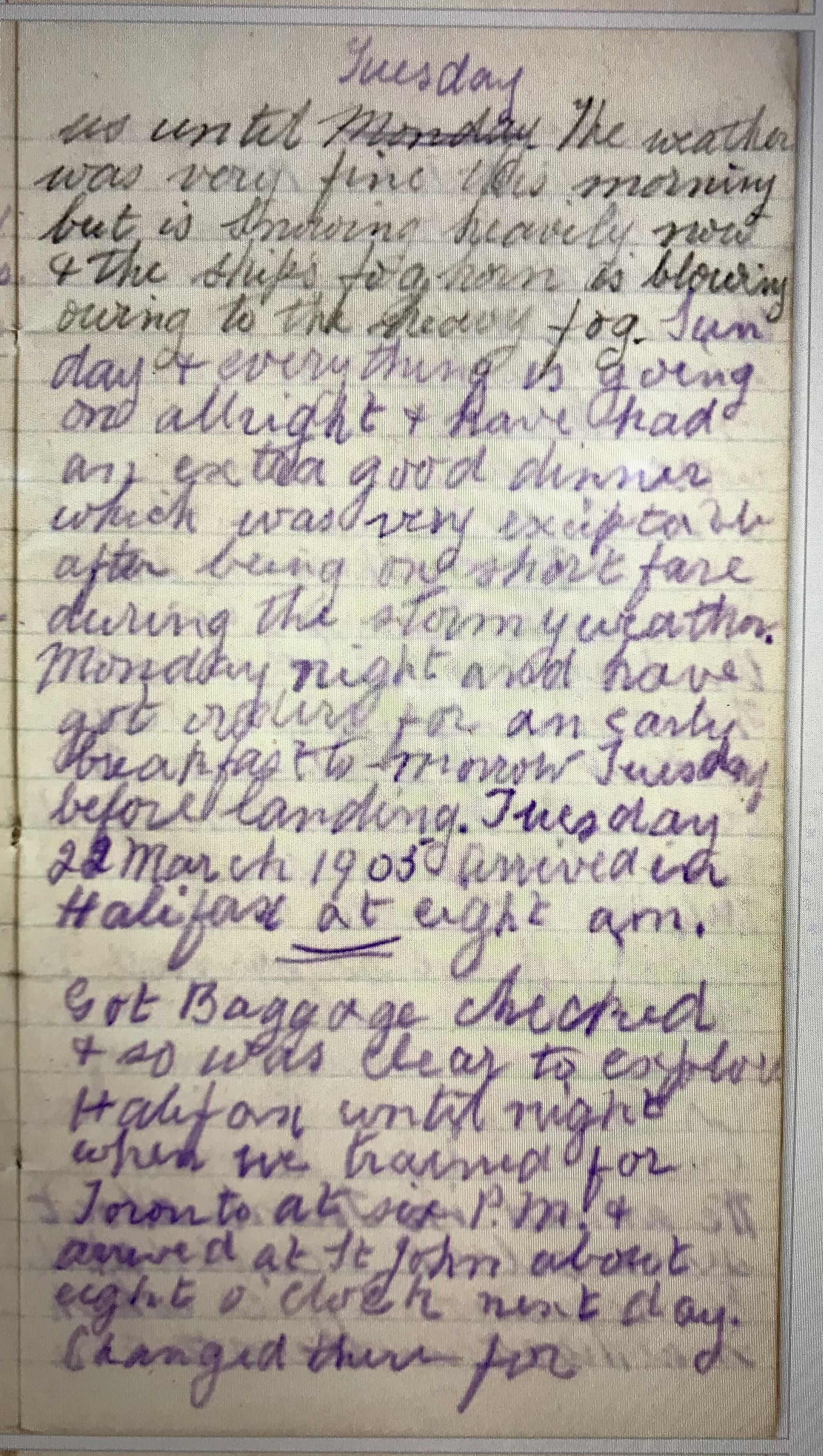
Transcription of Page Eight
“us until Tuesday. The weather was very fine this morning but is snowing heavily now & the ship’s foghorn is blowing owing to the heavy fog. Sunday & everything is going on alright & have had an extra good dinner which was very acceptable after being on short fare during the stormy weather. Monday night and have got orders for an early breakfast tomorrow Tuesday before landing. Tuesday 22 March 1905 arrived in Halifax at eight am.
_________
Got baggage checked & so was clear to explore Halifax until night when we trained for Toronto at six P.M. & arrived at St. John about eight o’clock next day. Changed there for”
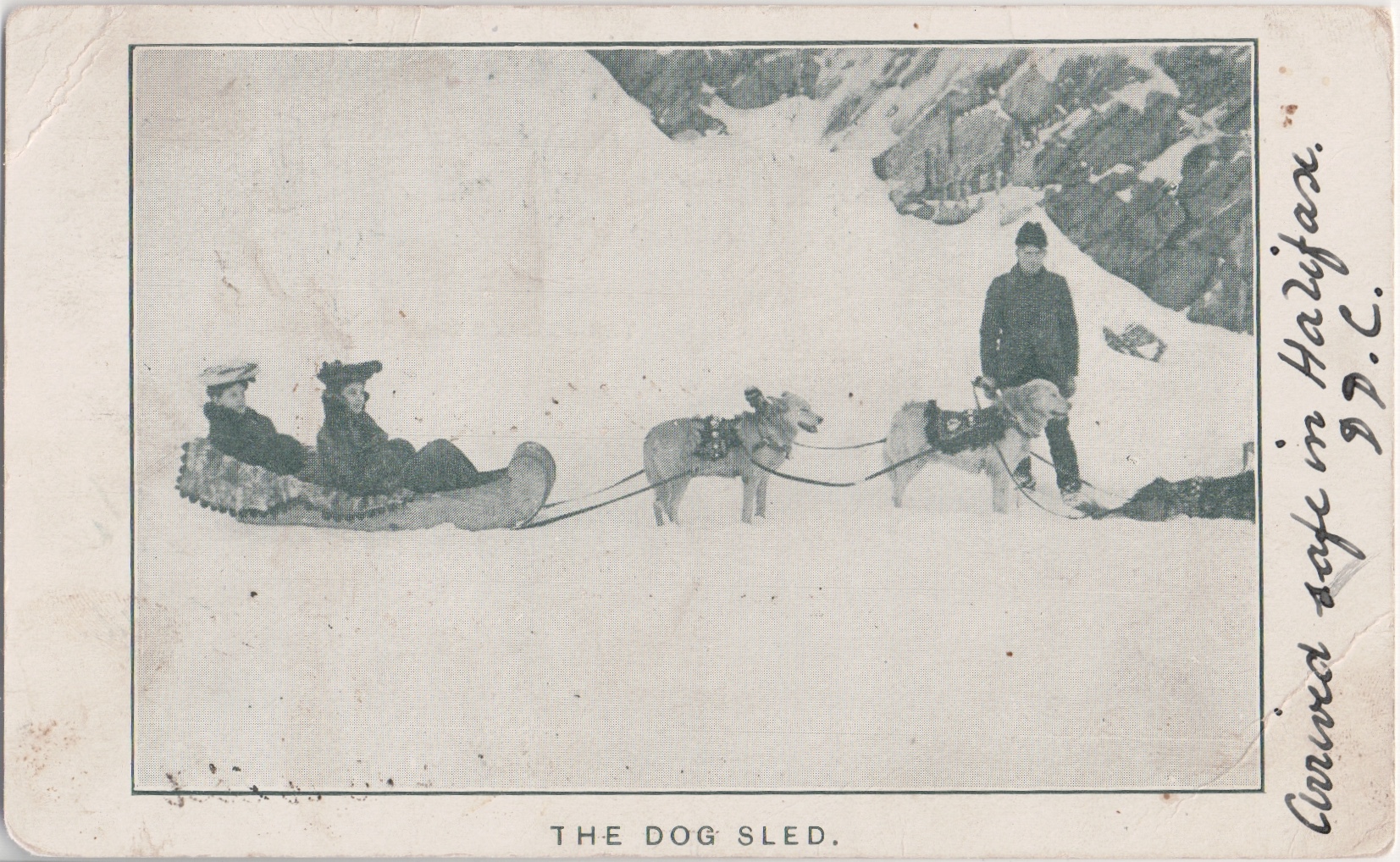
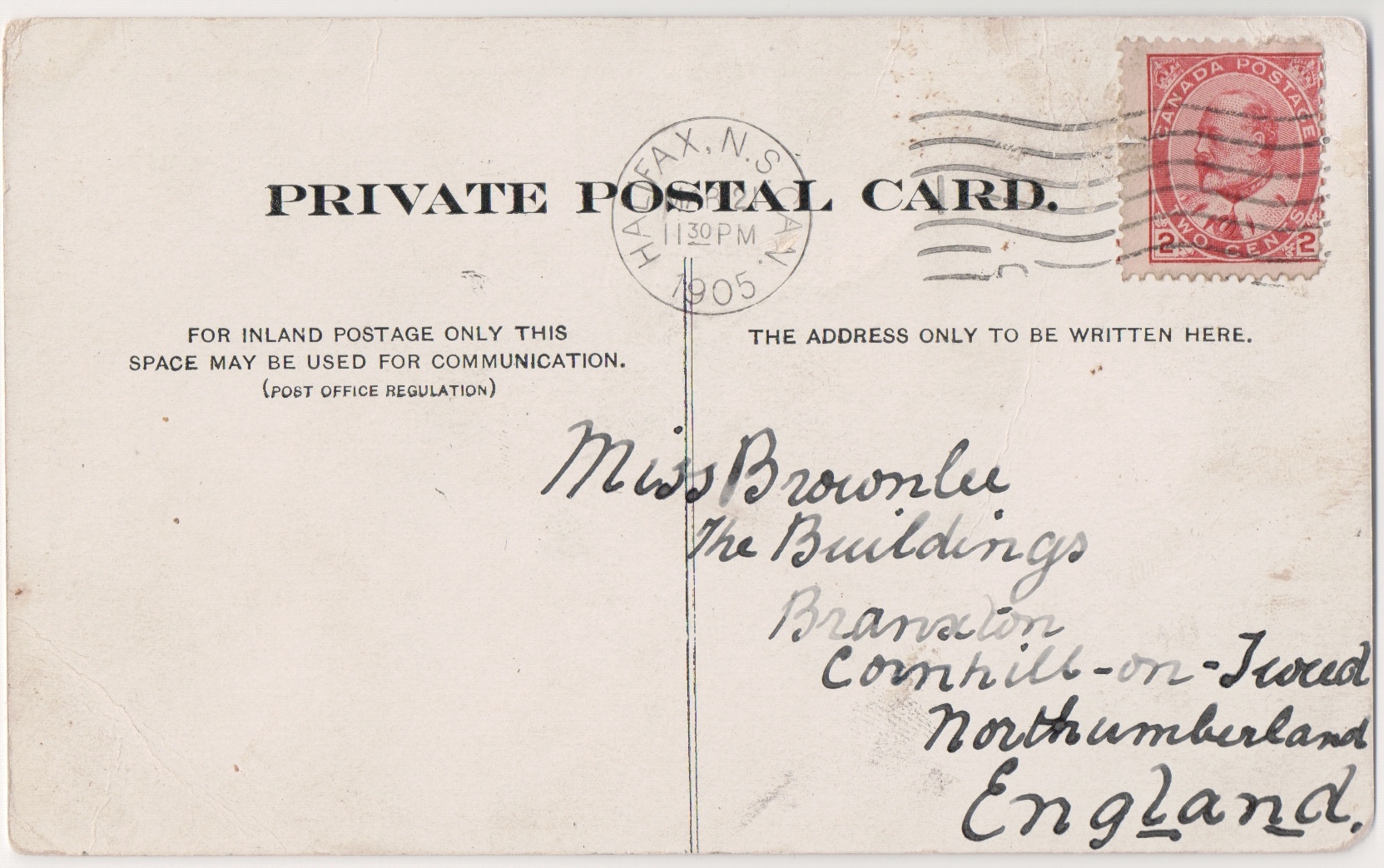
Note: While exploring Halifax Donald took time to purchase and send this post card back to his fiancée Isabella Brownlee in England noting his safe arrival:
This amusing postcard called “The Dog Sled” contains the brief message. “Arrived safe in Halifax. D.D.C.” Postal regulations at the time stipulated that for international mail the back of the post card could only be used for the name and address of the person to whom the card was sent. Thus, brief messages like this were usually included on the front of the card.The postcard is addressed to “Miss Brownlee, The Buildings, Branxton, Cornhill-on-Tweed, Northumberland. England”. Postmarked Halifax, N.S. Mar 21, 1905, 11:30 p.m.Isabella Allan Brownlees (1874-1958) in England. The locket she is wearing contains a photo of Donald Cameron.
Page Nine
Transcription of Page Nine
“Montreal after a stop of about half an hour & then got off along a very wild country of nothing but trees, the scenery being most beautiful & the weather splendid although there was a great deal of snow. Arrived in Montreal about three A.M. on Thursday 24th March. The Winnipeg party & the Toronto party separated, the former getting away about half past four & our party had to wait until nine thirty A.M. After giving the Western men a hearty send off we adjourned to the waiting hall until daylightwhen some of us explored the town & had breakfast before leaving.
We arrived in Toronto about seven o’clock & called at the Emigration office which is almost in the station”
Page Ten
Transcription of Page Ten:
“& were told to call back in the morning about half past nine. There was a man from there showed us to a Hotel where we got a bed & three meals for 75 cents. Next day Friday 25 March 1905 I got to the emigration office and had a talk with Geo. Jackson who wanted a man & so made bargain to go home with him that night for a month’s trial @ ten dollars for one month & 200 for one year. Left Toronto at half past four & arrived at Alma station about half past ten, two hours & a half late & then had three miles & half to walk in the dark with snow higher than the fences & going to the knees every step among half-melted”
Page Eleven
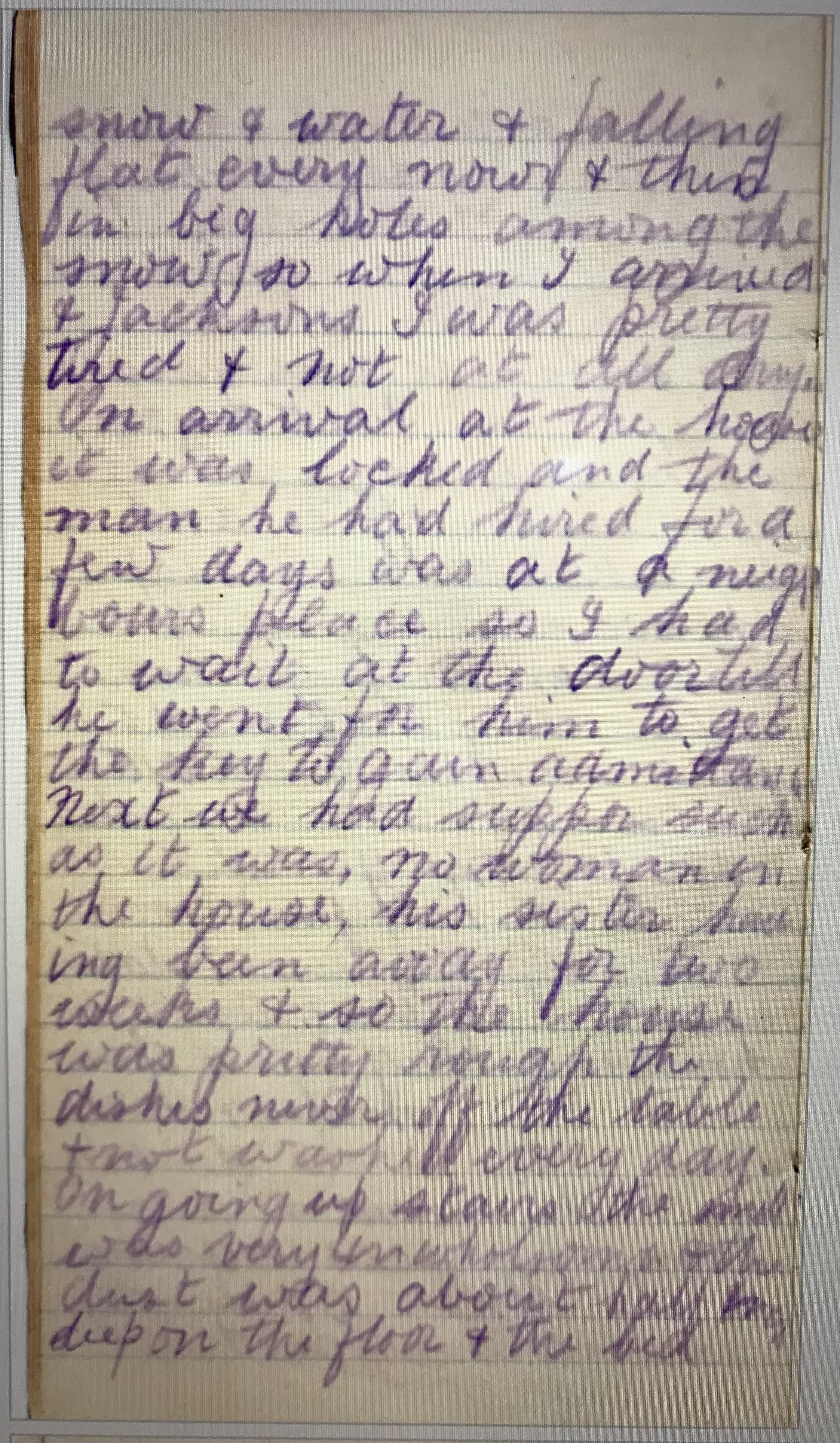
Transcription of Page Eleven:
“snow & water & falling flat every now & then in big holes among the snow so when I arrived at Jacksons I was pretty tired & not at all dry. On arrival at the house it was locked and the man he had hired for a few days was at a neighbours place so I had to wait at the door till he went for him to get the key to gain admittance. Next we had supper such as it was, no woman in the house, his sister having been away for two weeks & so the house was pretty rough the dishes never off the table & not washed every day. On going upstairs the smell was very unwholesome & the dust was about half inch deep on the floor & the bed”
Page Twelve
Transcription of Page Twelve:
“was not very nice the blankets being all holes so there was no other choice but fall in along with the other man a big rough looking fellow with a stripped jersey on but not such a bad sort after all was he John Green.
March 26. Saturday & started work just with the clothes I had on as it was impossible to carry my bag home & the roads being so bad could not get them home till Monday when Jackson & I went with the sledge for my box & bag with a pair of work horses. So after seeing the place a bit I thought it very rough & was not at all made up with my first job on Canadian soil.”
Page Thirteen
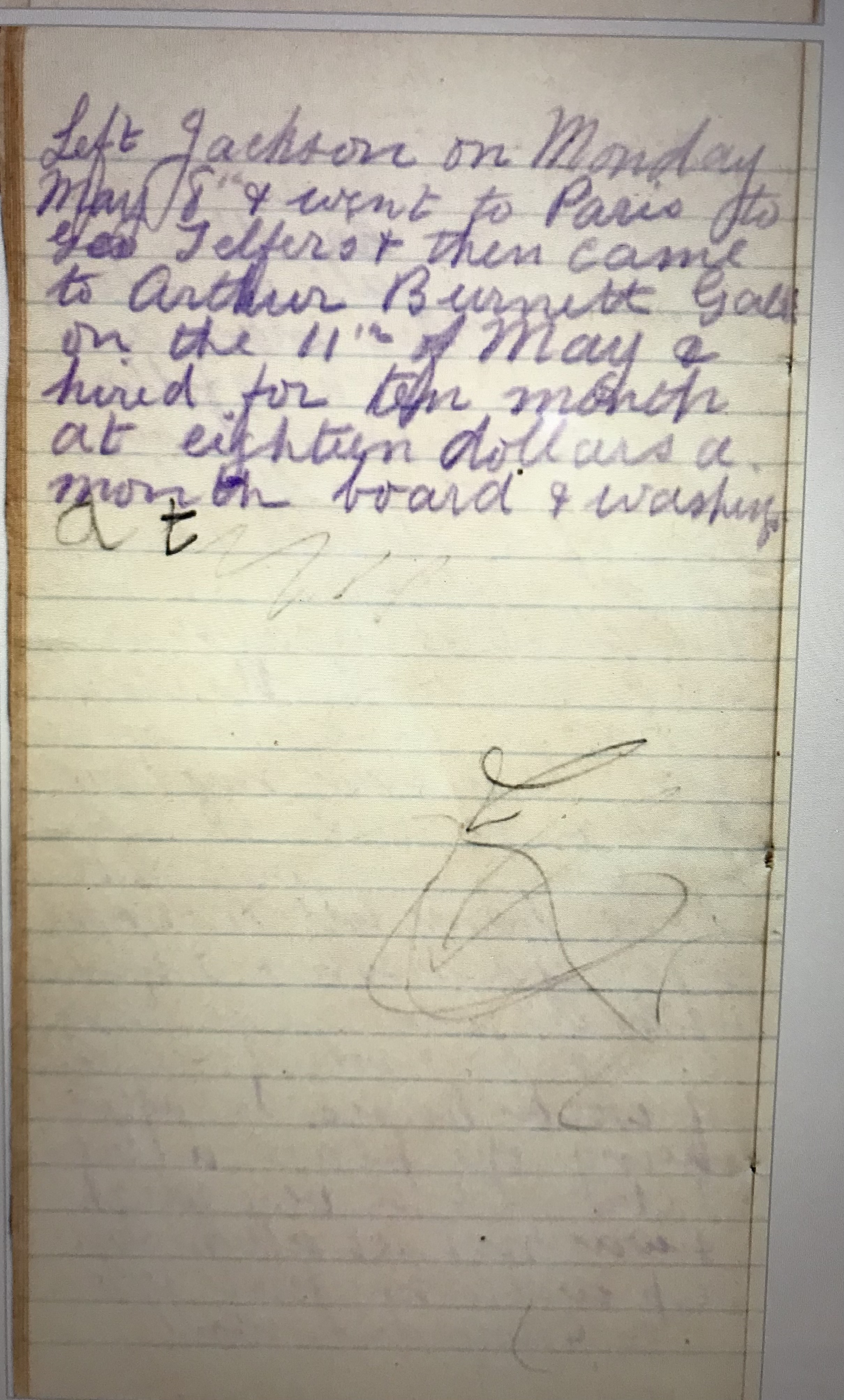
Transcription of Page Thirteen:
“Left Jackson on Monday May 8th and went to Paris [Ontario] to Geo Telfers& then came to Arthur Burnett Galt on the 11th of May & hired for ten months at eighteen dollars a month board & washing.”
****************
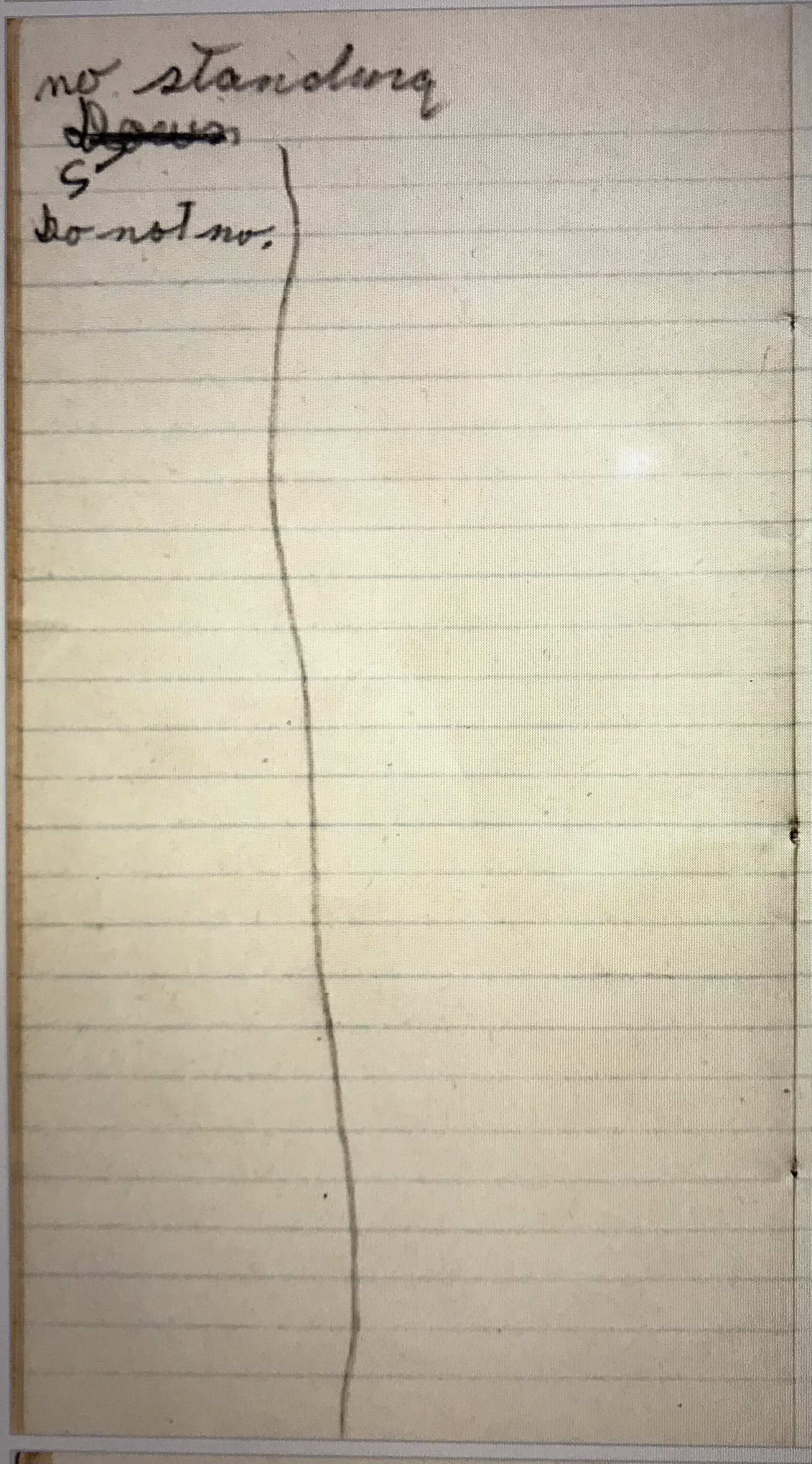
This is the end of the diary but on Pages 14 to 19 which are scanned below there are a few words, some notes & figures, and some scribbles: e.g Page 16 – “Cash Due up to 1st April 1907 $350, Page 17 -“Cash received from 1 April 1907. $4 & 40 cents Boots & Socks, $1 – overalls, $1 – By cash.” and on Page 19 what looks like a grocery list.
Pages 14 to 19
While working at Galt, Ontario for Arthur Burnett, Donald received a few post cards from friends and family, like the one below.
Post card addressed to “Mr. Cameron c/o Arthur Burnnett, Galt, Ontario, Canada. It was mailed from Cornhill on Tweed, England on Jun 13, 1905 and stamped again at Galt, Ontario on June 23, 1905. I think the initials “T.A.” belong to Grandma’s cousin Thomas Allan (1881-1939) who also lived at Cornhill-on-Tweed.The front of the post card above, showing the Cheviot Hills from Coldstream, Scotland, stamped at Hamilton, Ontario on Jun 23, 1905.
By the time of the 1906 census of Manitoba, which started on June 24th, Donald Cameron had finished his work experience at Galt and travelled on to Manitoba where he was living with his friend John Matthewson (1874-1947) and family at Woodnorth. The Matthewsons had travelled to Canada at the same time as Donald, on the Sarmatian, but they had gone directly to Manitoba. Donald bought his own farm nearby the Matthewsons and the two families remained lifelong friends. Isabella Brownlees sailed to Canada in June 1908, a much calmer crossing which took only seven days. She and Donald were married on June 30, 1908 at St. Andrew’s Presbyterian Church, also known as Daybreak Church, at Laggan, Manitoba, a few miles from Woodnorth which did not yet have a Church.
*******************
*******************
A Note on the ship SARMATIAN on which Donald Cameron sailed in 1905
The SARMATIAN was built and launched in 1871 by the Robert Steele & Company for the Allan Steamship line of Liverpool, England. It was 370 feet long and weighed 3647 tons. At that time it had three masts. In 1890 it was rebuilt with just two masts. In 1908 it was sold for scrap.
There are several sites online that give information about the ship and its many voyages. For example in the 1870s it brought thousands of Mennonites from Russia to Canada, many of whom settled in Manitoba. In 1878 it was chartered to bring Canada’s new Governor-General the Marquis of Lorne and his wife Princess Louise (daughter of Queen Victoria) to Canada.
Websites containing information about the Sarmation include:
The S.S. Sarmatian on the Mersey river off Liverpool, as she appeared before the rebuild in 1890. – Photographer: Unknown, colorized by Børge Solem. – Source: Norway Heritage Collection – License: CC BY-NC-ND 4.0
The S.S. Sarmatian as she appeared after the rebuild in 1890 with two masts. This image is from an old postcatd, it has been colorized by Borge Solem












 pamela forsyth